Ever dreamed of growing your own crystals at home? 🌟 You’re in luck—this DIY Magic Crystal Tree project is not only wildly colorful and eye-catching, but it’s also a simple science experiment that kids and adults will love. With just salt, cardboard, and a touch of household magic (ahem—ammonia and bluing), you’ll have dazzling crystals blooming in no time. As someone who’s spilled more than a few batches trying to get it just right, trust me—this is a must-try for curious minds and crafty hands alike.
What You Need to Grow a Magic Crystal Tree
Alright, let’s talk supplies. You might be surprised by how few things you need to grow a magic crystal tree at home—and most of them are probably hiding in your kitchen or laundry room. Seriously, I didn’t expect to find Mrs. Stewart’s Bluing under my sink, but there it was, tucked behind the dish soap. Classic.
Essential Ingredients That Actually Work
So, here’s what’s essential—and I mean that in the “don’t-skip-this-or-your-tree-won’t-grow” kind of way:
- Non-iodized salt – Either table salt or Epsom salt. Regular iodized stuff? Nope. I tried it once, and the crystals were weak. Like sad little ice flakes.
- Water – Distilled is great if you have it, but tap works too.
- Mrs. Stewart’s Bluing – This is the secret sauce. It’s not optional.
- Clear ammonia – Totally optional, but if you’re impatient like me, it’ll make your crystals grow way faster.
- Cardboard – Plain, non-corrugated. Think cereal box thickness. Anything thicker soaks too slowly.
Oh, and if you’re going for those vibrant colors that scream Pinterest-perfect, you’ll want some water-based food coloring too.
Why High-Quality Materials Matter
One mistake I made early on was using flimsy cardboard from a frozen pizza box. The crystals barely clung to it, and it turned soggy. Gross. Now I cut my trees from a leftover manila folder—strong enough to stand, but still absorbent. The right materials honestly make a huge difference, especially if you’re planning to show this off or use it as a DIY science fair project.
Another tip? Measure everything. Don’t eyeball it, or you’ll end up with a salt swamp. Been there. A little precision in mixing gives way better results.
Tools You’ll Need
- Scissors for shaping the tree.
- A shallow dish (I use an old saucer—RIP to my matching set).
- Measuring spoon (yes, it matters).
- A small whisk or fork to mix the solution. Trust me, stirring with a butter knife sucks.
I swear, the first time I did this, I thought I could skip the whisk. Nope. Ended up with a clumpy mess and zero sparkle. Lesson learned.
The Real Secret? A Warm, Dry Spot
This part I learned the hard way. If your house is humid (looking at you, Florida), it’s going to slow things down. I leave mine near a window that gets morning sun. Within hours—bam—tiny sparkles start to bloom. Science, baby.
So now you’re prepped! Grab your gear and let’s grow some crystals.
Step-by-Step Guide to Making Your Magic Crystal Tree
Okay, now for the fun part—actually making your magic crystal tree! I’ve messed this up a few times, so let me walk you through what works (and what totally doesn’t). Trust me, this is one of those DIY science experiments that looks magical when done right but turns into a soggy disaster if you rush it.
Step 1: Cut and Build Your Cardboard Tree
Start by cutting a simple tree shape. Don’t overthink it—two identical pieces with a slit halfway up/down so they can interlock like a 3D puzzle. If you’re doing a flat version, even easier.
I once got fancy and tried to make a tree with curvy branches and, well… the crystals had no idea where to stick. Keep it basic. The structure needs surface area and stability. Use non-corrugated cardboard or manila folders. Those absorb the solution without collapsing.
Step 2: Add Food Coloring for a Rainbow Effect
This part’s optional, but why not go full rainbow? Add water-based food coloring to the tips of your cardboard branches. I usually use a drop of blue and red together—gives you a nice purple burst.
Heads up: skip the gel kind. It doesn’t absorb properly and will just leave blobs.
Step 3: Mix Your Magic Solution
In your shallow dish, combine:
- 2 tablespoons non-iodized salt
- 2 tablespoons Mrs. Stewart’s Bluing
- 2 tablespoons water
- ½ to 1 tablespoon clear ammonia (I go full tablespoon for fast results)
Stir it well with a small whisk or fork. If the salt doesn’t fully dissolve, that’s fine. It’ll still work. Just don’t leave big salty chunks sitting there.
Once I forgot the ammonia. Took forever to see any crystals. With it? I had full branches by bedtime.
Step 4: Set It and Forget It (Kinda)
Place your cardboard tree upright in the dish. Make sure it’s touching the solution at the bottom. Then put the dish somewhere warm and dry. I use the top of my fridge—it’s like a mini desert up there.
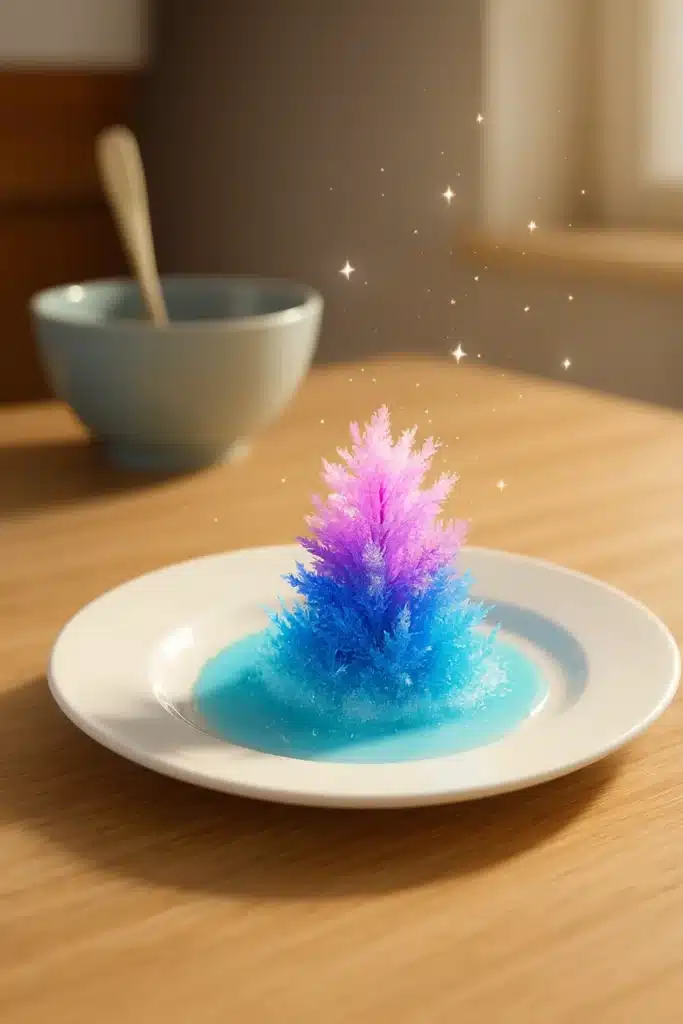
Within 4–6 hours, you’ll see crystals forming. By the next morning? Boom. You’ve got a fully grown crystal tree that looks like a cotton candy sculpture. I’ve even had some that started dripping color like it was blooming.
Extra Tip: Don’t Move It Mid-Growth
Seriously, let it be. I once tried to “check progress” by tilting the dish. Big mistake. Everything slid off and melted. It was like watching a sandcastle collapse.
Science Behind the Magic – How Crystals Form
Okay, I’ll admit it—I didn’t totally get the science behind this at first. I was just in it for the sparkle. But once I saw how fast those crystals formed, I had to know why. And let me tell you, this is one sneaky way to sneak in a legit science experiment for kids (or curious adults like me).
Evaporation is the Real MVP
Here’s what’s happening: when you mix salt, water, and bluing, you’re making a supersaturated solution. That means there’s more salt than the water can usually hold, but it does because the water’s warm or freshly mixed. Once the tree soaks up the liquid and the water starts to evaporate—boom—crystals start growing right on the cardboard fibers.
I used to think crystals just “froze” out of liquid or something. Nope. It’s all about evaporation pulling the salt out and leaving it behind in those cool jagged shapes.
The Role of Salt, Bluing, and Ammonia
So why do you need all three?
- Salt is what forms the crystals—obvious one.
- Bluing (which contains iron) helps the solution spread evenly across the cardboard. It’s weirdly magical. Without it, the crystals don’t branch out as much.
- Ammonia speeds up evaporation. That’s why when I used just salt and water, it took two days. With ammonia? One night.
And yes, it’s safe in small amounts—but make sure there’s airflow in the room and keep it away from little hands.
Capillary Action = Tiny Tree Plumbing
This part’s wild: your cardboard tree acts like a sponge. Water moves upward through the fibers in a process called capillary action. It’s the same thing plants use to pull water from their roots to their leaves. So, your flat little tree is actually behaving like a real one. Kinda poetic, right?
Teaching Chemistry Without the Boring Bits
If you’re a parent or teacher, this is a genius way to introduce chemistry for kids. Instead of memorizing terms, they see what saturation, evaporation, and crystal formation look like. I did this with my niece last summer and she asked if we could “grow a rainbow forest” next. Total win.
So yeah, even if you’re not a science nerd, this part is super cool. Understanding how crystals form adds a whole new level of “whoa” to your project.
Tips for Growing Bigger and Brighter Crystals
Okay, I’ve grown a lot of these magic crystal trees—some came out looking like a science fair trophy, and others? Like someone sneezed salt onto cardboard. If you’re like me and want those big, sparkly crystals that look like sugar-coated art, here’s what I’ve learned the hard way.
1. Use the Right Amount of Salt and Ammonia
Too little salt and you’ll barely see any crystal growth. Too much, and it just clumps up at the bottom. I stick to 2 tablespoons of salt and 1 full tablespoon of ammonia for fast crystal growth. That combo? Chef’s kiss. The ammonia speeds evaporation and the salt brings the sparkle.
One time I doubled the salt thinking, “More crystals, right?” Nope. It turned into slush and nothing stuck to the tree.
2. Warm, Dry Air Is Your Best Friend
I live in a place where humidity is a thing—and let me tell you, moisture is a crystal killer. The crystals need water to leave the solution so they can form. If the air is damp, nothing dries out and your tree just sits there looking sad.
Now I always set mine near a sunny window or even in a room with a space heater nearby (but not blowing directly on it). You want warmth and dryness—like desert vibes. That’s key to growing bigger crystals.
3. Add Color Before, Not After
I used to add food coloring after the tree was set up. Didn’t work. The color just pooled at the bottom. But if you drop the food dye on the cardboard tips before you pour the solution, the colors soak in and rise with the liquid. That gives you those gorgeous tie-dye crystal tips.
4. Don’t Over-Mix the Solution
I used to stir like a madman, thinking I had to fully dissolve the salt. Turns out, a few crystals undissolved at the bottom is fine—it actually helps seed the growth. So stir just enough, don’t obsess. Over-mixing can make your solution cloudy and sluggish.
5. Try Different Shapes and Cuts
Wider branches = more surface area = more crystals. I tested this by making one tree super narrow and another with big fat limbs. The wide one came out loaded. The narrow one? Sparse. So yeah, make your tree a bit bushy if you want that full bloom.
Bonus Tip: Let It Sit for 24 Hours
Patience is hard, I know. But even after it looks “done,” leave it for another day. I’ve had crystals double in size just by leaving the tree alone longer.
So if you want your crystal tree to turn heads (or go viral on Pinterest), follow these little tricks. It’s seriously satisfying when you see those chunky, colorful crystals bloom like candy floss.
Fun Variations and Display Ideas
Once you’ve made one of these trees, it’s hard not to get a little obsessed. I started with just a basic cardboard pine, and now? I’ve got a mini crystal forest growing on my bookshelf. If you’re into DIY crystal crafts or looking for creative ways to show off your new science skills, here are some ideas that actually work—and won’t fall apart after a day.
1. Make a Whole Crystal Forest
Instead of one tree, try making three or four smaller ones. Vary the heights and branch styles, and cluster them together on one plate. Add different food coloring to each one for a total rainbow crystal forest effect. It’s great as a centerpiece—especially around the holidays.
My nephew called it “the sparkly jungle,” and honestly? He wasn’t wrong.
2. Play With Shapes (Not Just Trees!)
Who says it has to be a tree? I’ve done stars, hearts, snowflakes—you name it. Just make sure the base shape has lots of edges or points. Crystals love clinging to edges. A simple folded star made from an old cereal box turned out amazing—the crystals grew off every little point like frozen fireworks.
3. Mount on Wood or Canvas for Decor
If you want something more permanent, let the tree dry completely and then gently hot glue it to a small piece of reclaimed wood or a canvas board. Boom—homemade science gifts that don’t look like a 5th-grade project. My sister actually framed one of mine and hung it in her laundry room. Not mad about that.
4. Add LED Lights for a Glow-Up
One weekend I had leftover fairy lights and a bored Sunday. I wrapped a tiny LED strand around the base of the tree and turned it on in the dark. The crystals lit up like a tiny ice sculpture. Magical doesn’t even cover it. If you’re doing this for a school science fair or party, it’s a killer touch.
5. Use as Place Cards or Gift Toppers
Tiny versions of these trees make super cute place settings for dinner or even fancy gift toppers. Write someone’s name on the base and boom—handmade, sparkly gift tag that’ll get more attention than the gift itself.
So yeah, once you make your first one, don’t stop there. Crystals are kind of addictive, and there are so many ways to use them beyond just watching them grow.
So there you have it—your complete guide to making a magic crystal tree that actually works (and looks awesome). From gathering the right materials to troubleshooting soggy disasters, I’ve messed up enough batches to know what makes this DIY science project really shine.
If you’ve ever wanted to combine creativity, science, and a little bit of magic, this is the one. Whether you’re using it as a DIY science experiment for your kids, a Pinterest-worthy craft project, or just a way to fill a rainy afternoon, watching those crystals bloom never gets old. It’s like your kitchen turns into a mini chemistry lab—and the best part? You don’t need fancy gear or a Ph.D. to make it happen.
And hey, if you try this at home and it works (or even if it flops hilariously), snap a pic and post it on Pinterest! You’ll inspire other makers and curious minds out there. Who knows—your glittery tree might just be the next pin to go viral.
So go on, grab some salt and cardboard, and let the crystal magic begin. 💫