Winter isn’t just for hot cocoa and snowball fights—it’s also the perfect time for a bit of science magic at home! If you’re a parent or teacher looking to mix learning with fun, this crystal snowman craft is a must-try. With just a few household supplies, kids can watch in awe as baking soda crystals grow like ice on a rainbow-colored snowman. It’s a dazzling way to explore evaporation, crystal formation, and absorption—all while making a sparkly winter decoration. One mom told me her son said it was like “growing Elsa’s magic in real life.” That’s a win in my book!
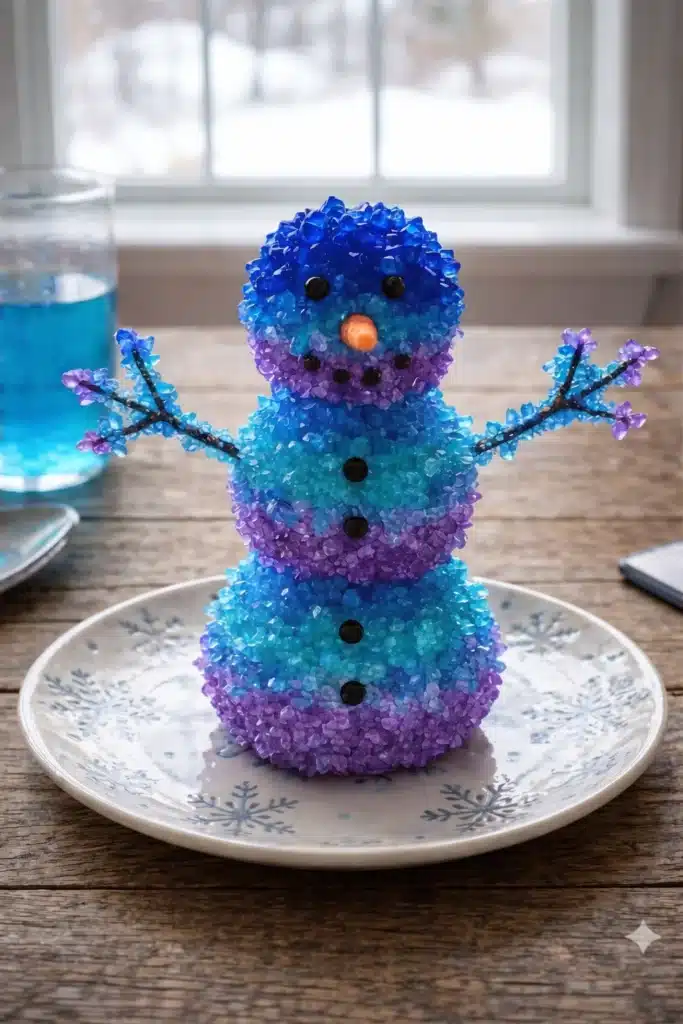
Materials Needed for Your DIY Crystal Snowman
Let me be real with you—nothing’s worse than diving into a craft with the kids and realizing you’re missing a key supply. Been there, done that, and ended up with a glitter-covered toddler and no snowman to show for it. So, here’s the real prep list before the mess begins!
✔️ The Basics: Stuff You Probably Have Lying Around
You’ll need some kind of absorbent material for the snowman base. I’ve used thick paper towels, sponges, even leftover cardboard from cereal boxes. If it can soak up liquid, it’s fair game.
- White cardboard or sponge – These work best for holding the crystal structure
- Scissors & glue – You’ll cut out three circles (big, medium, small) to stack like a snowman
- Black marker – Or you can get fancy with mini black beads for eyes and buttons
- Orange triangle (paper or clay) – That’s the nose, and yes, a broken crayon works too!
Honestly, the nose part gets creative. One year, I used a dried-up orange marker cap. It worked…kinda.
🎨 Color It Up: Make It Magical
Now this part is where the kids lose their minds. Liquid food coloring turns this into a full-blown STEM art project.
- Liquid food coloring (red, blue, yellow, etc.) – Use bold colors for best results
- Optional but fun: glitter or fine salt – Adds that frosty shimmer
Pro tip? Use a spoon or dropper to create “rainbow zones.” Kids LOVE seeing their snowman turn into a tie-dye crystal beast. And if you’re doing this for a holiday craft for children, those colors really pop under Christmas lights!
🧪 The Science-y Part: Crystals Need Chemistry
Here’s where the magic happens. You’re gonna make a saturated baking soda solution. It’s like alchemy… but with pantry stuff.
- 1 cup very hot water – Not boiling, but close. Adult supervision, obviously.
- ½ cup baking soda – Stir until you can’t anymore. That’s how you know it’s saturated.
- Optional: table salt – If you want those sparkly “snowflakes” to look extra icy
One time I added too much water and the snowman turned into a soggy ghost. So yeah—don’t overdo it.
🥄 Final Tools: Don’t Skip These
These aren’t flashy, but they make your life easier. Trust me.
- Shallow dish or plastic plate – It helps the solution spread evenly
- Spoon or dropper – For gently adding the solution around the snowman base
This is one of those DIY science experiments that feels like a mix between preschool playtime and a National Geographic show. It’s also killer if you need a quick homeschool activity or something to fill a snowy afternoon.
Before you start, gather everything on a tray and lay it out like you’re hosting a tiny science show. I do this every time now—less chaos, more learning.
Oh, and if your kids are anything like mine, make extra. One crystal snowman is never enough.
Step-by-Step Instructions for Growing Crystals on a Snowman
Alright, here’s where the real fun kicks in—and if you’re like me, the real mess too. But I promise it’s worth it. This little snowman might look innocent, but it’s a full-on science experiment for kids disguised as a cute craft. Just follow these steps and you’ll be watching baking soda crystals form like you’re running your own holiday-themed lab.
1. Cut and Stack the Snowman Base
Grab your absorbent material—paper towel, sponge, whatever you’ve got. Cut out three circles: one big, one medium, and one small. Think snowman size, not pizza size.
- Stack them from largest to smallest.
- Use glue to attach them (a glue stick works fine unless you’re dealing with sponges).
Let it dry completely. And yeah, this step is kind of boring, but rushing it means your snowman might flop before the real magic begins. Learned that the hard way during one of our first tries.
2. Add the Snowman’s Face and Details
Now it’s time to make it look like a snowman. This is where the kids really shine with creativity. I’ve seen everything from sparkly unicorn snowmen to one that looked like a mini Frankenstein.
- Marker for eyes and buttons, or glue on beads if you’re fancy.
- Orange triangle for the carrot nose—paper, clay, a chunk of foam, whatever.
- Want arms? Use toothpicks or pipe cleaners.
Remember, this isn’t just a DIY holiday craft—it’s part of the build-up for the science bit. So, make it cute and sturdy.
3. Color It Up With Food Coloring
This step is a total game-changer. Drip food coloring onto the snowman like you’re creating a rainbow snow cone. Try stripes, dots, or just let your kid go nuts. We once did galaxy colors—blue, purple, and black—and it looked incredible when the crystals formed.
- Let the colors soak in for a couple minutes before moving to the next step.
This isn’t just about aesthetics. The food coloring helps make this an educational winter activity because it visually shows how the liquid travels up the material. Sneaky science win!
4. Make the Magic Crystal Solution
Okay, here’s where your kitchen turns into a mini lab.
- Mix 1 cup of very hot water (adult job!) with ½ cup of baking soda.
- Stir like crazy until it stops dissolving. A bit of powder at the bottom means it’s saturated—and that’s perfect.
We call this the “snowman juice” at home. Don’t drink it, obviously.
5. Drip the Solution Around the Base
Set your snowman upright in a shallow dish or on a plate. Then slowly spoon or drip your solution around the base. You want the liquid to creep up—not flood the poor guy.
- The solution should absorb upward over time. That’s capillary action, baby!
This step feels slow at first. But give it an hour or two, and you’ll start seeing teeny crystals forming like nature’s glitter.
6. Wait and Watch the Crystals Grow
Here’s the secret sauce: patience. The best crystals take time.
- After 1–2 hours, you’ll see early formations.
- After 6–12 hours? You’ll have a rainbow snowman covered in sparkly ice.
Don’t move it while it’s growing. Seriously—don’t. I did once and it looked like a crushed snow taco. Let it sit somewhere warm and dry.
7. Dry and Display
Once it’s fully crystallized, let the snowman dry out completely. The baking soda will harden, locking in the color and sparkle.
We’ve used ours as window decorations and even ornaments. Just make sure it’s out of reach of humidity or curious toddlers.
Honestly, this is one of my go-to STEM learning at home projects because it blends art, science, and a bit of holiday magic. Plus, there’s nothing cooler than hearing a five-year-old say “Look! I grew crystals!”
The Science Behind the Sparkle: How Crystals Form
Alright, confession time: the first time I did this activity, I thought the crystals were just from the glitter we added. 😂 Nope! The real sparkle comes from actual science, and once you understand how it works, it’s even cooler.
If you’re using this as part of your STEM education toolkit, this section is gold. Or sparkly white gold, I guess.
🧪 What’s Actually Happening Here?
So when you mix baking soda with very hot water, you’re creating a saturated solution. That means the water holds as much baking soda as it physically can. Any extra just sits at the bottom and waits.
Now, once this solution gets soaked up into your snowman (thanks to good ol’ capillary action), the water starts doing its thing—evaporating.
And that’s where the magic starts.
💡 How Crystals Form (In Kid-Friendly Speak)
As the water evaporates, there’s nowhere for the baking soda to go, so it latches onto the fibers in the paper or sponge. Over time, it starts forming those jagged, beautiful, snowflake-like structures we call crystals.
It’s the same basic science behind rock candy or salt crystals—except this time it’s decked out in rainbow colors and looks like something Elsa would’ve made during a chemistry class.
🤓 Capillary Action: Nature’s Plumbing Trick
Here’s a fun visual: imagine tiny tubes inside your paper towel pulling water up like a straw. That’s capillary action, and it’s what makes your snowman drink up the solution from the plate.
One time, my kid asked if the snowman was “eating the juice,” and honestly, that’s not too far off. The water gets sucked in, moves up, then poof—evaporates and leaves sparkly snow behind.
🌡️ Temperature & Crystal Growth
Now, here’s where it gets interesting. If your room is warm and dry, the water evaporates faster, and smaller crystals tend to form. Cooler and slower? You get fewer but larger crystals.
We did a little side-by-side experiment once—one snowman in the sun, one on the porch—and the porch one had chunky, jagged crystals that looked like rock candy. The kids were obsessed.
🧠 Turn It Into a Real Lesson
If you’re a teacher or homeschool parent, this is an easy segue into talking about:
- Evaporation
- Saturation
- States of matter
- Solubility and temperature
Seriously, it’s one of those rare science lessons at home where the kids are glued in—and you barely have to explain anything because the snowman does all the talking.
This whole process is more than just a pretty craft. It’s a hands-on baking soda experiment that teaches real chemistry without needing a lab coat or Bunsen burner. Honestly, it’s stuff like this that makes science stick. Sparkly + educational? Count me in.
Tips and Tricks for the Best Crystal Snowman
I’m just gonna say it—this isn’t one of those “set it and forget it” crafts. Nope. Your snowman needs a little TLC if you want those crystals to really sparkle. I’ve messed this up more than once (RIP to the snowman that melted into mush because I used too much water). So let me save you the trial-and-error drama with a few hard-earned tips.
✅ Choose the Right Base
You want something absorbent, but not too flimsy.
- Paper towels work, but they can wilt if soaked too much.
- Sponge pieces or thick coffee filters are sturdier.
- Cardboard? It’s hit or miss. It’ll soak, but slowly.
We once used construction paper because we were out of sponges—big mistake. It barely soaked and the crystals looked like sad, chalky dandruff.
✅ Get the Saturation Just Right
You want the baking soda solution to be saturated. That means you’ve added enough baking soda so that it won’t fully dissolve. A little gritty stuff at the bottom is exactly what you want.
If you go too light on the baking soda? Crystals won’t form.
Too much water? The snowman drowns. Dramatic, but true.
This is where DIY science kits sometimes win—they give you the perfect ratio. But hey, I like doing it the messy, home-style way.
✅ Add Sparkle (The Smart Way)
If your kid’s anything like mine, glitter is non-negotiable. But timing matters.
- Add glitter after the food coloring but before the baking soda solution.
- Or sprinkle it over the top once the crystals start growing.
Don’t stir it into the baking soda mix. It messes with the crystal structure. I learned that after ending up with a sludgy rainbow swamp. Cool-looking… but not crystal-y.
✅ Ideal Growing Conditions
This is where things get a little science-y. Crystals grow best in:
- Warm, dry rooms – speeds up evaporation
- Still environments – avoid drafty windows or shaking the table
- Shallow dishes – too deep and your snowman soaks like a sponge in a bathtub
I like setting ours near a sunny window, but not in the sun. The indirect warmth does wonders. Just keep it away from the heater—unless you want a mutant snowman with crusty arms.
✅ Bonus Tips for Crafting Success
- Pre-cut all your snowman parts and set them on a tray—great for group activities
- Want faster results? Use thinner paper or a smaller snowman
- Got leftover baking soda? Use it for a volcano experiment later—double win!
And hey, if you’re doing this as part of STEM projects for kids, try having them predict which materials grow crystals fastest. It turns into a mini science fair right on your kitchen counter.
This project may look simple, but the devil’s in the details. I’ve done it enough times to know what works—and what ends in soggy disappointment. Trust me, follow these crystal growing tips, and you’ll get a snowman so sparkly, it might just earn a spot on your mantel.
Displaying Your Crystal Snowman as Winter Decor
So, your snowman is done, crystallized, and looking like it just walked out of a frozen fairy tale. Now what? Well, don’t just let that sparkle go unnoticed! Let’s talk how to display your crystal snowman so it doesn’t end up forgotten on a craft shelf or (worse) stuck to a paper towel in the corner.
I’ve made this mistake—left one too close to a humid window, and it turned into a slushy blob by morning. Let me help you avoid that sad ending.
🧊 Let It Dry—Completely
Before you even think about moving your snowman, let it sit for at least 24 hours in a dry place. This allows the crystals to harden fully, like icing on a gingerbread house.
- I usually leave it overnight on a sunny windowsill (away from steam or heat vents)
- Paper towel underneath is smart until it’s bone-dry
Once I tried moving one after just six hours. Big mistake. It crumbled like a sugar cookie.
🌟 Best Places to Show It Off
When dry, your sparkly snowman becomes the perfect DIY winter decoration. Here are my go-to spots:
- Windowsills – where light hits the crystals just right
- Bookshelves or mantels – mix with pinecones and candles for a cozy vibe
- Holiday centerpieces – put it in a glass bowl with fake snow
One year, we turned them into name cards for a holiday dinner—little snowmen with glittery initials. Got so many compliments!
📦 Storage Tips (If You Want to Keep It)
Now, here’s the thing. These little guys are fragile. Super fragile. Like “don’t even breathe on them too hard” fragile.
- Store in a dry container with silica gel packets
- Wrap gently in tissue paper
- Avoid plastic bags—they trap moisture
We’ve managed to keep one snowman for over a year using a shoebox and a dry closet. Still looks good! Kinda impressive for a holiday craft for children, right?
🏫 Use It as an Educational Display
If you’re doing this in a homeschool or classroom, your crystal snowman isn’t just decor—it’s a conversation starter.
- Pair it with a simple science explanation card
- Add a magnifying glass for closer inspection
- Use it as part of a “winter STEM table” with other science crafts
One teacher friend even used them as a classroom window display titled “Let It Grow!” Genius.
The best part? These snowmen aren’t just cute—they’re proof that learning and crafting can collide in the coolest way. Whether you’re showing off your educational craft or just adding sparkle to your holiday table, give your crystal snowman the attention it deserves.
And just like that—you’ve turned a handful of household items into a winter wonderland science show. From cutting the base to watching those crystals grow hour by hour, this crystal snowman project mixes creativity and chemistry in the most magical way. Whether you’re using it as part of your STEM activities for kids or just looking for a fun educational holiday craft, it’s the kind of hands-on experience they’ll actually remember.
For me, this isn’t just a one-time craft. It’s a seasonal tradition now. The excitement on my kid’s face every time the crystals start to peek through? Pure joy. And honestly, it never gets old—even for me.
So go ahead—grab that baking soda and start your own snowy science adventure. Add a little glitter, a little color, and a whole lot of curiosity.
🖼️ Tried it already? Snap a pic of your sparkly masterpiece and share it on Pinterest! Inspire other families, teachers, and creative minds to give this awesome project a go. Trust me, your snowman is Pinterest-worthy.
And if you found this helpful, pin it to your Winter Crafts, Homeschool STEM, or Holiday Activities board—it helps more than you know.