“Whoa! It’s growing crystals!” That’s what my 7-year-old shouted when we tried this snowflake growing experiment for the first time. If you’re looking for a science activity that actually gets your kids excited, you’ve found it.
This simple DIY lets children witness crystal formation in real time — like watching winter magic happen in a dish. With just Epsom salt, hot water, and a snowflake shape, you’ll mix chemistry, creativity, and winter wonder into one unforgettable experiment. Whether you’re a parent, teacher, or a curious kid-at-heart, this guide will show you exactly how to make your own sparkling snowflakes at home.
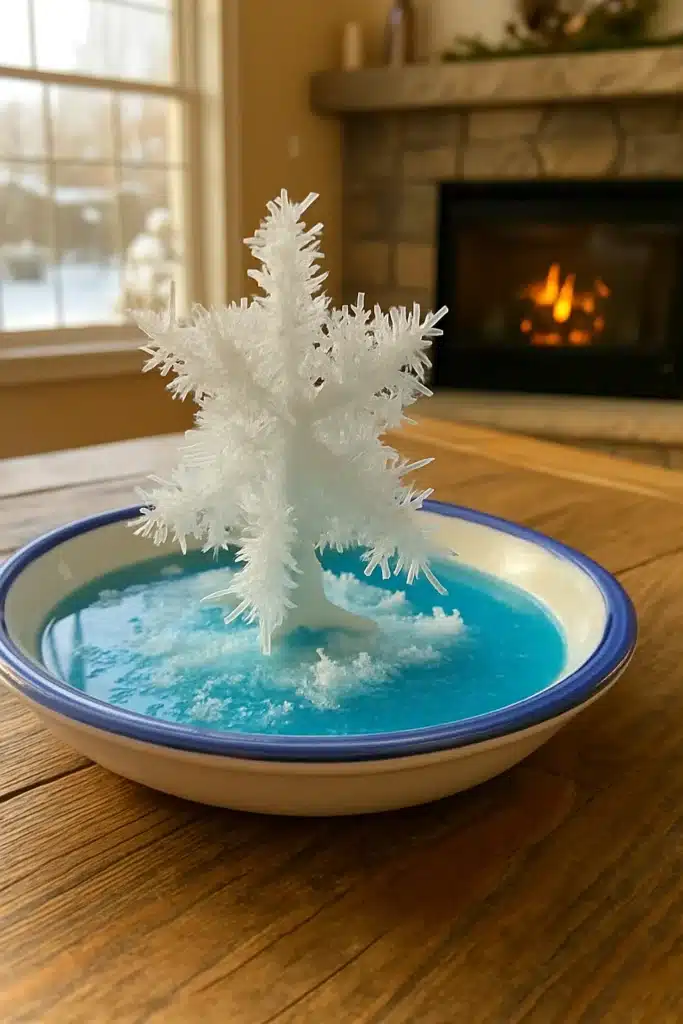
What You’ll Need to Grow Crystal Snowflakes
Okay, I’ve gotta admit — the first time I tried this snowflake growing experiment, I totally forgot the spoon. Rookie move. But hey, that’s how you learn, right? If you’re gearing up for a fun STEM activity for kids this winter, here’s everything you need to set yourself up for crystal-growing success.
🎒 Gather These Supplies
Let’s keep it simple. You’ll probably already have most of this stuff lying around:
- 1 cup of very hot water — seriously, not lukewarm. I used water just below boiling. (I’ve tried warm water before, and yeah… nada grew.)
- ½ cup of Epsom salt — the magnesium sulfate kind. Don’t substitute table salt — trust me, been there, didn’t work.
- Clear, shallow dish or bowl — glass works best so you can watch the magic happen from the side!
- Pipe cleaners — white or blue look super icy, but you do you.
- Food coloring (optional) — a few drops of blue makes the crystals pop, but skip it if you want the classic frost look.
- Spoon — learned this the hard way.
- Stand or tape/clay — you’ll want the snowflake standing upright, not face-planting into the solution.
I tried using cardboard once instead of pipe cleaners. Yeah, it soaked up all the water and got soggy before crystals even thought about growing. Lesson learned: go with pipe cleaners or plastic snowflake ornaments. If you’re doing this as an educational craft with a class or a homeschool group, prepping a few ahead of time will save your sanity.
🧼 Safety Side Note
Hot water and kids? Not a combo you wanna freestyle. I always handle the heating part and let the kids do the mixing and snowflake design. That way it stays a hands-on science experiment without, you know, anyone getting burned.
I usually lay everything out in a little “science lab station” style. Kids LOVE that. Give ’em a tray, their materials, and suddenly they’re mini chemists. Bonus tip: keep paper towels handy. One bump and that salty water goes everywhere.
This is one of those winter projects that doubles as both a craft and a legit science learning activity. Whether you’re doing it at home or in a classroom, it checks so many boxes: fun, educational, cheap, and full of “ooooh” moments.
How to Make the Crystal Solution
I’ll be honest — this part felt like magic the first time I did it. I mean, who knew that stirring salt into water could set off something that looks like snowflakes blooming out of nowhere? If you’ve ever looked at those fancy crystal growing kits and thought “meh, overpriced,” this DIY version is your best friend. Seriously, it’s just two ingredients.
🧪 The Science-y Stuff (But Make It Easy)
Alright, grab that cup of very hot water. I usually microwave mine for about 90 seconds, but you can also heat it on the stove — just don’t boil it. Boiling is too much. We want hot, but not lava.
Now, slowly — and I mean slowly — add in ½ cup of Epsom salt while stirring. You’ll feel like it’s never gonna dissolve completely. That’s actually the point. When you’ve stirred until just a little salt stays undissolved at the bottom? Boom. That’s your supersaturated solution. It’s loaded up with as much salt as the water can hold, which is exactly what you want for epic crystal formation.
If you’re doing this as part of a STEM learning activity, pause here and explain saturation to the kids. I used a little analogy about trying to fit more and more sugar into tea until it just sits at the bottom. Made it stick.
🎨 Want to Add Color?
Now here’s where it gets fun. You can keep the solution clear for a frosty look or add a couple drops of blue food coloring for that icy vibe. I’ve tried red before — kinda looked like alien coral. Cool, but not very snowflake-y. Stick to cool tones for a winter effect.
⚠️ Quick Warning From Experience
Whatever you do, don’t pour the solution directly onto the snowflake. I did this once in a rush and the force of the liquid knocked my little snowflake sideways. It looked like the aftermath of a snowstorm — in the worst way. Always pour the solution gently next to the snowflake, just enough to cover the bottom of the dish.
That’s it — no fancy lab coat needed. Just some salt, hot water, and a good stir. If you’re helping kids learn how to grow crystals at home, this step shows them that science doesn’t need to be complicated to be cool.
Forming the Snowflake Shape
Now this part — this is where creativity meets science. I’ve done this STEM snowflake activity a bunch of times now, and every single snowflake turns out different. Just like the real ones, right?
🧵 Pipe Cleaners Are Your Best Friend
If you’re going the DIY route, which I totally recommend, grab some pipe cleaners. The fuzzy ones, not the stiff plastic kind — they soak in just enough solution without turning into mush. I usually use three of them: twist one straight down the center, then cross the other two diagonally to make a six-pointed star.
It doesn’t need to be perfect. Seriously. The first time I tried, one side looked like a lobster claw. But the crystals don’t care about symmetry — they’ll still grow in the coolest ways.
If you’re doing this as a winter craft for kids, let them freestyle their designs. Some of the snowflakes my daughter made looked like ninja stars. And they still turned out beautifully.
🔁 Alternatives That Also Work (Mostly)
I once tried using a sponge cut into a snowflake shape. It kinda worked… but not great. The sponge sucked up a lot of the solution and didn’t give the crystals much to grow on. Cardboard? Worse. It just curled and disintegrated.
Plastic ornaments shaped like snowflakes — the cheap ones from the dollar store — actually work decently. Not quite as textured, but the crystals still cling on.
🧍 How to Keep It Upright (This Is Key)
Here’s a trick I didn’t know at first: your snowflake needs to stand up. If it’s lying flat in the dish, the side touching the dish gets all the crystals and the top stays bald. Not the look we’re going for.
So I either:
- Stick the snowflake in a small lump of clay or playdough,
- Tape the stem to a pencil laid across the top of the dish, or
- Wedge it upright using little rocks or beads.
It’s like setting up a tiny sculpture garden.
If you’re doing this for homemade holiday decorations, the upright snowflake ends up looking way cooler once it’s dry and sparkly. I usually add a little ribbon loop and hang ’em in the window. Instant winter magic!
The Crystal Growing Process
Okay, this is the part where the magic actually happens — and if you’re anything like me, you’ll be checking the dish every 10 minutes at first. Don’t. It’s like watching water boil… but colder.
🌡️ Pick the Right Spot
After you pour in the solution and set up your snowflake, place the dish somewhere warm and totally undisturbed. That part is key. I once left it on the windowsill, and it got bumped twice by a flying Lego car. Crystals? Zero. Nada.
Now I always use the top of my bookshelf — no drafts, no pets, and no tiny toy missiles. If you’re doing this as a crystal science experiment for a class or group, make a sign: “Do Not Touch — Science Happening!”
⏱️ How Long It Takes (Spoiler: Not That Long!)
Crystals usually start forming in 30 to 90 minutes. You’ll notice tiny spikes, like frozen fur, growing outward from the snowflake. It’s wild. My youngest called them “ice caterpillars.”
For full coverage, though, leave it overnight — anywhere from 6 to 12 hours. I usually set it up in the evening and by morning, it’s a glittery masterpiece. It’s one of the most satisfying things you can do for an easy STEM project.
Oh, and if you live somewhere cold and your house gets chilly at night? Even better. Cooler air helps the solution cool slowly, which encourages better crystal formation.
👀 What’s Actually Happening?
If your kids are asking (or you’re just curious like I was), here’s the simple explanation: as the solution cools, it can’t hold as much dissolved salt. So the salt “falls out” and forms crystals on the pipe cleaner. Boom — a winter science lesson and a cool decoration, all in one.
I always say it’s like watching science decorate a snowflake in real time. And that moment when the kids yell “It’s working!” — yeah, that’s the gold.
Displaying and Preserving Your Snowflake
Alright, your crystals have grown, the snowflake’s sparkly, and now comes the trickiest part: getting it out of the dish without wrecking your hard-earned work. I’ve messed this up more times than I’d like to admit, so let me walk you through how to do it right.
🧼 Handle With Care (Seriously, It’s Fragile)
Once the crystals are fully formed, don’t touch them right away. Give it another hour or so to fully cool and set — the crystals are still kind of soft and can break if you rush it. I’ve lost some beautiful flakes to my own impatience.
To remove the snowflake, gently lift it from the dish using tweezers or your fingers (just be super careful). Set it on a paper towel or coffee filter to dry. A paper towel with texture works great because it absorbs moisture fast without sticking to the crystals.
This is where it becomes a true crystal ornament DIY masterpiece.
🧵 Add Some Flair and Keep It Pretty
I like to tie a little piece of ribbon or clear fishing line to the top and hang it in a sunny window. On a frosty morning? Chef’s kiss. The sunlight makes the salt crystals shimmer like actual ice. If you’re using this for a holiday science craft, these also look amazing on Christmas trees or strung together as garland.
Sometimes the crystals will flake a bit when moved, and that’s normal. But if you want to preserve homemade snowflakes longer, I’ve had good luck lightly spraying them with a clear acrylic spray (just the kind from a craft store). One quick coat keeps them sturdy.
🖼️ Where to Show Them Off
Here are some of my favorite ways to display crystal crafts around the house:
- Hang in windows with suction hooks
- Attach to gift bags as a handmade tag
- String a few on yarn for a wintery banner
- Use as centerpieces in clear mason jars
The first time I did this with my kids, we gave some as gifts to grandparents. Instant win. They’re beautiful, handmade, and come with a mini science story. It doesn’t get better than that.
And just like that, you’ve turned salt and water into something straight out of Frozen. ❄️
And there you have it — a full-blown crystal snowflake craft that’s part science, part art, and totally magical. Whether you’re homeschooling, teaching a classroom, or just keeping the kiddos entertained on a snow day, this winter science activity is always a win.
What I love most is how it sneaks in so much learning while feeling like play. Kids are absorbing real chemistry concepts — supersaturation, crystallization, molecular structure — but they think they’re just making shiny snowflakes. And honestly? That’s the best kind of educational DIY project.
Every time we do this, it’s different. The shapes, the growth patterns, the sparkle… they never turn out the same way twice. Just like real snowflakes.
So go grab your Epsom salt, twist some pipe cleaners, and give it a shot. You’ll be surprised how fun science can be when it looks like a snow globe exploded in your kitchen.
💡 Loved this idea? Save it to Pinterest and share it with other parents, teachers, or crafty folks who’d love to try it too. Let’s spread the sparkle and science together!


Fantastic!!!!