Ever seen a rainbow grow in real life? Well, you’re about to! 🌈 In this magical DIY science experiment, we’re going to mix a little science with a splash of art—and end up with something totally mesmerizing. With just a few pantry staples and a dash of creativity, you and the kids can make your very own Baking Soda Rainbow Crystal Trees that look like they belong in a fairy village.
This isn’t just fun—it’s science in action. Crystals will form before your eyes as your mini trees blossom with rainbow-hued fluff. And guess what? It’s crazy easy.
So grab your baking soda and let’s grow something spectacular.
What Are Baking Soda Crystal Trees?
So the first time I stumbled onto this baking soda science experiment, I honestly thought it was a Pinterest prank. You’re telling me I can make a crystal growing kit outta hot water, food coloring, and stuff from my pantry? But y’all—it worked. It really worked. My kids were completely glued to the dish like they were watching a volcano erupt in slow motion.
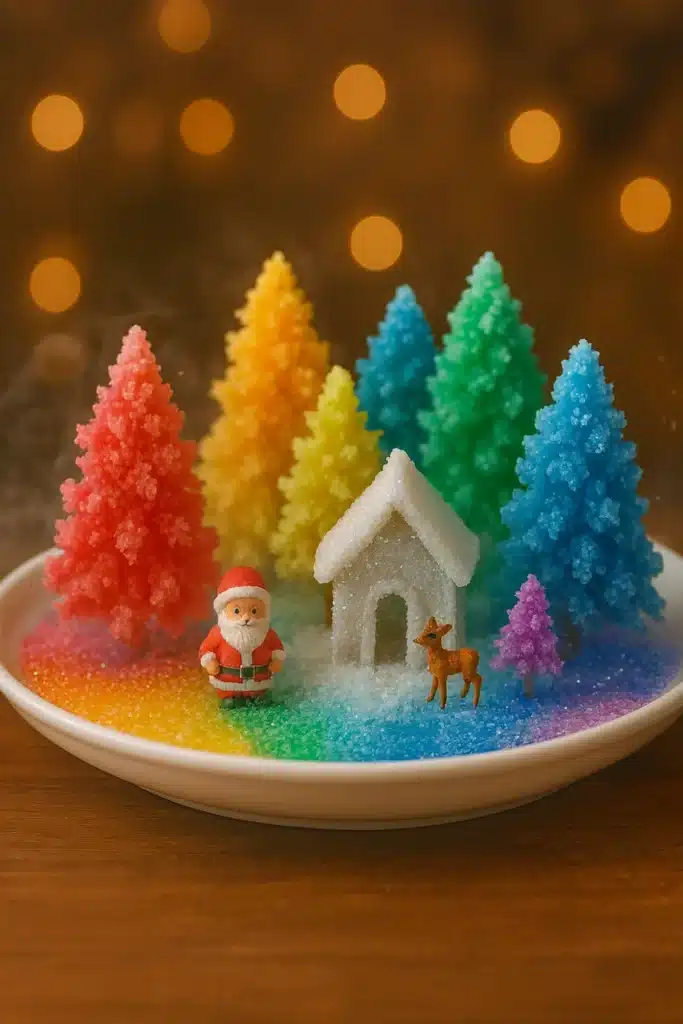
This magical little trick is officially called a baking soda crystal tree, and it’s basically a rainbow-colored science experiment for kids that makes sparkly fluff grow on mini trees. Think: pipe cleaners twisted into tree shapes, dipped into a special saturated solution. Within hours—boom. Crystals.
🌱 The Science Is Actually Kinda Cool
Okay, science nerd moment: When you mix baking soda into hot water until it won’t dissolve anymore, you’ve got a supersaturated solution. As it cools down and evaporates, the baking soda starts crystallizing out—clinging to whatever it can. Enter: your cute lil’ sponge trees.
The crystals grow along the shapes, and because we added food coloring earlier, they turn into soft rainbow fluffs that look like candy-coated branches. My youngest called them “frosty unicorn trees,” and honestly, he nailed it.
🧠 Why It’s More Than Just a Pretty Craft
Besides the wow factor, this activity checks off every STEM box. It’s hands-on, teaches about crystal formation, touches on chemistry concepts like saturation and evaporation, and still lets the kids get messy with color mixing. Perfect for homeschool or just rainy day STEM activities at home.
Plus, unlike those fancy store-bought crystal growing kits that cost an arm and a leg, this one’s practically free. You probably already have everything in your kitchen. Win-win.
😬 What I Messed Up the First Time
True story: I tried to rush it by using lukewarm water and didn’t fully dissolve the baking soda. Spoiler alert—zero crystals. Nada. You have to use hot water and mix it like you’re making the world’s saltiest soup. Also, don’t jostle the dish once the trees are in place. Any movement messes with the crystal growth.
Now I always do a test run when the kids are napping so I don’t disappoint them with a dud. Trust me—it’s worth the prep.
💡 Pro Tips for Perfect Crystals
- Use white sponge or pipe cleaners so colors show up bright
- Stir baking soda until no more dissolves—a little undissolved grit at the bottom is actually a good sign
- Leave your setup somewhere warm and still (window sills are great)
- If you want swirl effects, add plain water in the center right before it starts growing
- Add fine glitter if your kids are into sparkle (mine are obsessed)
So yeah, baking soda crystal trees? Way cooler than I ever expected. They’re not just crafts—they’re memory-makers with a whole lotta science baked in. 🌈
Materials You’ll Need for Your Rainbow Crystal Village
Alright, before we dive into crystal-making magic, let’s talk supplies. The beauty of this DIY science experiment is how ridiculously simple it is to set up. Seriously—this is cheaper than a coffee run, and way more exciting than another screen-time fight. 😂
When I first did this project, I tried to use what I had lying around—and turns out, you don’t need some fancy STEM science kit. Just a few basics and you’re in business.
🧺 The Basics You’ll Need
Here’s what’s on my go-to list every time we build our “rainbow crystal village”:
- Shallow white plate or dish – this lets the colors really pop
- Hot water – I just microwave a cup for 90 seconds
- Baking soda – lots of it! I go through about ¾ cup per 1 cup of water
- Food coloring – rainbow colors are the most fun (red, orange, yellow, green, blue, purple)
- Mini trees – use sponge pieces cut into tree shapes, or twisted pipe cleaners
- Small cups or bowls – for mixing your baking soda solution
- Spoon or stir stick – your basic science wand 🪄
- Optional: fine glitter – if you want sparkle (and yes, you do)
🔍 Where to Find Tree Materials
So I didn’t have tiny tree sponges the first time. I improvised. I cut up a dish sponge into triangles and stuck toothpicks in the bottom to help them stand. Worked like a charm.
Later, I hit up the dollar store and grabbed a pack of colored pipe cleaners—twisted ‘em into loopy little trees, and BOOM. Insta-forest. If you wanna go full-on craft mode, they also sell pre-shaped foam tree kits, but honestly? Homemade ones look just as magical.
😬 Learn from My Supply Fails
One time I tried using a plastic plate that wasn’t flat. Big mistake. The water pooled in one spot and all the colors ran together into a sad brown soup. Ugh. Make sure your dish has a smooth, even surface so the rainbow spreads properly.
Oh—and don’t skip the white background. I used a dark blue plate once thinking it’d look “cooler.” It didn’t. The colors just vanished.
🛒 Budget-Friendly Bonus
Don’t stress about buying some overpriced crystal growing kit. This is one of those rare science crafts for kids that costs next to nothing. I got most of our supplies from the dollar bin or repurposed them from around the house. Honestly, the only real “investment” is the baking soda—but even that’s dirt cheap.
🧙 Pro Tip: Set Up Before You Call the Kids
Trust me on this. Do all the prep before you invite the kids to help. That way, they get the fun part (pouring and watching crystals grow), and you don’t get a baking soda explosion on your counter. Been there.
Step-by-Step Instructions to Grow Your Crystal Trees
Alright, let’s get into the really fun part—growing your own baking soda rainbow crystal trees. 🎉 I swear, every time I do this with the kids, I feel like some sort of science wizard. It’s like alchemy but with glitter and food coloring.
The first time I tried this STEM experiment, I was convinced I’d mess it up. Spoiler: I didn’t! You just have to follow the steps and let the science do its thing. Here’s how we do it at home:
Step 1: Create Your Rainbow Base
Start by pouring a thin layer of hot water into your white plate. I use about ½ inch of water—just enough to cover the bottom. Then, carefully drop in your food coloring in a rainbow pattern. Don’t stir—just let the colors swirl and do their magic.
Pro tip: If your food coloring is super concentrated, one drop per color is plenty. Too much and it’ll just turn into a murky mess.
Step 2: Set Up the Trees
This is where your creativity comes in. Shape your pipe cleaner trees or place your sponge trees upright in the plate. Try to space them out a bit so they each get a chance to shine.
I once jammed five trees too close together, thinking it’d look cool. It didn’t. They fused into one mutant rainbow lump. Lesson learned.
Step 3: Make Your Baking Soda Solution
In a separate cup, heat 1 cup of water (I microwave it for 90 seconds), then stir in baking soda until no more dissolves. I usually use around ¾ cup. Stir like your life depends on it. You want a supersaturated solution—that’s the sciencey magic sauce that’ll grow your crystals.
Let a little baking soda settle at the bottom. That’s actually a good sign you’ve reached saturation.
Step 4: Pour the Solution Around the Trees
Now, slowly pour the hot baking soda mix around the base of your trees. Do this gently—if you pour too fast, you’ll disturb the rainbow pattern underneath.
Hot tip: I pour it down the side of the plate or use a spoon to control the flow. Less splash, more sparkle.
Step 5: Wait and Watch the Crystals Grow
Set the whole plate somewhere warm and undisturbed. A sunny window works great. Within 1 to 12 hours, you’ll start to see crystals forming like frost on a window. It’s wild.
Sometimes they grow crazy fast—like, within the hour. Other times they take all day. Don’t stress. It’s all part of the process.
For a fun effect, I sometimes add a splash of plain hot water to the center before growth starts. It creates this soft swirl that looks super cool once the crystals start popping.
📌 Troubleshooting Your Crystal Forest
No crystals? You may have under-saturated the solution. Try stirring in more baking soda.
Colors look muddy? Could be too much food coloring or your dish isn’t flat.
Crystals only on the bottom? That’s normal at first! Be patient—they’ll climb the trees soon.
I remember one time my youngest was so disappointed after an hour of zero growth. We left it overnight and BOOM—by breakfast, it looked like a glitter bomb went off in an elf village.
This DIY crystal activity is one of those rare projects that actually turns out better than the Pinterest photo. Plus, it’s a low-mess, high-impact way to teach crystal formation for kids without needing borax or dangerous chemicals. Just good ol’ baking soda and science.
Fun Tips to Make Your Crystal Tree Village Extra Magical
Now that you’ve got your crystal trees growing like champs, let’s talk decoration. This is where the real fun begins—turning your science project into a full-blown crystal tree village that looks like something straight outta a fairy tale.
My kids absolutely lose it when we do this part. They call it “tree town,” and every time we do a new version, they invent stories about who lives there. Last time it was unicorns and marshmallow bears. 😂
Add More Trees for a Forest Vibe
You don’t have to stop at one or two trees. I like making five or six small ones and spacing them around the plate to make a tiny forest. Use different colors of pipe cleaners or sponge shapes so each one feels unique.
Try twisting the pipe cleaners into spirals or hearts—get weird with it. That’s half the fun. It turns your STEM craft idea into a full-blown creative science project.
Bring in the Mini Magic
Here’s where things get extra cute. After the crystals have grown and dried, we like to add tiny decorations—like mini fairy lights, glitter snowflakes, or even little toy animals. You can also snip up paper to make teeny houses or glue bottle caps down as “ponds.”
We once used a small battery tea light and put a crystal tree over it. The glow through the crystals? Insane. Looked like something out of a Pixar movie.
Sprinkle with Glitter (Carefully)
Glitter isn’t required, but let’s be real—it levels up everything. I use a superfine shimmer glitter so it sticks better to the crystals while they’re still wet. Just a little sprinkle and boom—kids science activity turned into sparkle city.
But heads up: glitter gets everywhere. Do it over a baking tray or outside unless you want a glitter kitchen for the next week. (Ask me how I know.)
Themed Tree Villages
One time we did a winter theme—all white trees with blue and silver crystals. Another time we went full rainbow unicorn with every color possible. You could even do a Halloween version with orange and black, or Valentine’s trees with pink, red, and purple.
Let your kids pick a theme and run wild. It’s amazing how much creativity comes out when they take the lead. And suddenly, this isn’t just a DIY crystal craft—it’s a whole experience.
Display Your Work
When the trees are fully dried, we carefully transfer the whole plate to a sunny window or a shelf. Pro tip: let it dry completely so it doesn’t fall apart when you move it. We’ve even sprayed a light coat of clear craft sealant once to help preserve the crystals longer. Not necessary, but it helps.
We keep ours up for a few days, then gently clean it out and start again with a new theme. It’s become a seasonal tradition now—and one of our favorite easy DIY crafts.
So yeah, go wild with it. Let your rainbow tree village shine. You’re not just doing a science project—you’re making memories covered in sparkle and STEM.
Cleanup and Storage Tips
Let’s be real for a sec—every awesome kids science activity ends the same way: a beautiful mess. 😅 And while baking soda is one of the most low-key science ingredients out there, those sparkly rainbow trees do leave behind a bit of chaos.
But hey, no stress. Cleanup is actually easier than you’d think—as long as you know what you’re doing. (Spoiler: I didn’t the first time. My sink was not happy.)
Don’t Dump It All in the Sink
Okay, biggest tip first: do not pour leftover baking soda water down the drain, especially if there’s still undissolved powder. I learned this the hard way after clogging our kitchen sink trying to rinse out a plate full of gunky crystals. Baking soda builds up and can harden in the pipes if you’re not careful.
Instead, scrape out as much of the dried mix as you can into the trash first. Then rinse the dish with warm water in small amounts.
If the crystals are still stuck, soak the plate in warm vinegar water for a few minutes. The vinegar reacts with the baking soda and breaks it down—science saves the day again.
Handling the Crystals
Once you’re done showing off your rainbow crystal village and you’re ready to move on, you can toss the dried crystals into the trash. They’re safe, but fragile—don’t expect them to survive a move.
Sometimes we keep our best-looking tree or two and gently set them aside to dry completely. I’ve tried sealing them in little jars with a sprinkle of glitter—it’s like a snow globe without the water. Super cute keepsake!
But honestly, most of the time we enjoy the project, snap a bunch of photos, and then clean it out for the next round. That’s the fun of it—it’s a cycle of creativity.
Cleaning the Plate or Dish
For plates with stuck-on baking soda, here’s what works best:
- Fill with warm water and let it sit for 15-30 minutes
- Use a plastic scraper or sponge—no metal scrubbers, they’ll scratch
- Add vinegar if the baking soda has hardened—instant fizz and easy wipe-away
- Rinse with hot water and dry with a towel
I always do this part myself, even if the kids beg to help. Because one time my oldest tried to “help” by rinsing glittery baking soda over the cat’s water bowl. 🐱 Let’s just say Mr. Whiskers was not amused.
Storage Tips
Not much to store here unless you’re saving the trees, but I do keep a “crystal kit” in a bin now. I stash a few pipe cleaners, food coloring bottles, and a box of baking soda together so I’m not scrambling when the kids ask to do it again (which happens a lot).
We also label the bin “SCIENCE STUFF” so it doesn’t get mixed up with random art supplies. I try to keep things a little organized… keyword “try.”
Doing science at home shouldn’t feel like a chore. With a few smart cleanup tricks and some prep, this safe science experiment cleanup is just as easy as setting it up.
If you’ve made it this far, congrats—you’re officially part wizard, part scientist, and definitely a very cool grown-up. 🧪✨ Whether you’re homeschooling, planning a rainy-day activity, or just looking for something different that doesn’t involve screens, these Baking Soda Rainbow Crystal Trees hit the sweet spot between fun, learning, and wow-factor.
It’s not just a fun science for kids activity—it’s an invitation to explore, experiment, and create something truly beautiful. You’re teaching your kids how crystals form, what saturation means, how colors mix… and how to be patient while something magical takes shape. (Okay, maybe the last one’s a work in progress. 😅)
Every time we do this, the results are different. Sometimes the trees puff up like snowballs, other times they shimmer in neon swirls. That’s what makes it so exciting—it’s science, but with the heart of a DIY rainbow craft.
So here’s your next step:
🌟 Snap a pic of your masterpiece.
📌 Pin it on Pinterest.
💬 Share it with other curious crafters and science lovers!
Trust me, your friends will want to try it too—and you’ll be the one who brought a little color and curiosity into their homes.
Go ahead. Let your creativity grow—and don’t forget to sprinkle in some glitter.