“Whoa, it’s growing!” That’s the kind of reaction you can expect when you try this easy, colorful science activity at home. If your kids love hands-on experiments or you just want to sprinkle a little magic into a rainy afternoon, learning how to make your own growing baking soda forest is the perfect mix of science and art. Using only baking soda, hot water, and a dash of color, you’ll spark curiosity and awe right from your kitchen table. Let’s dive into this snowy, sparkly forest world that seems to grow right before your eyes!
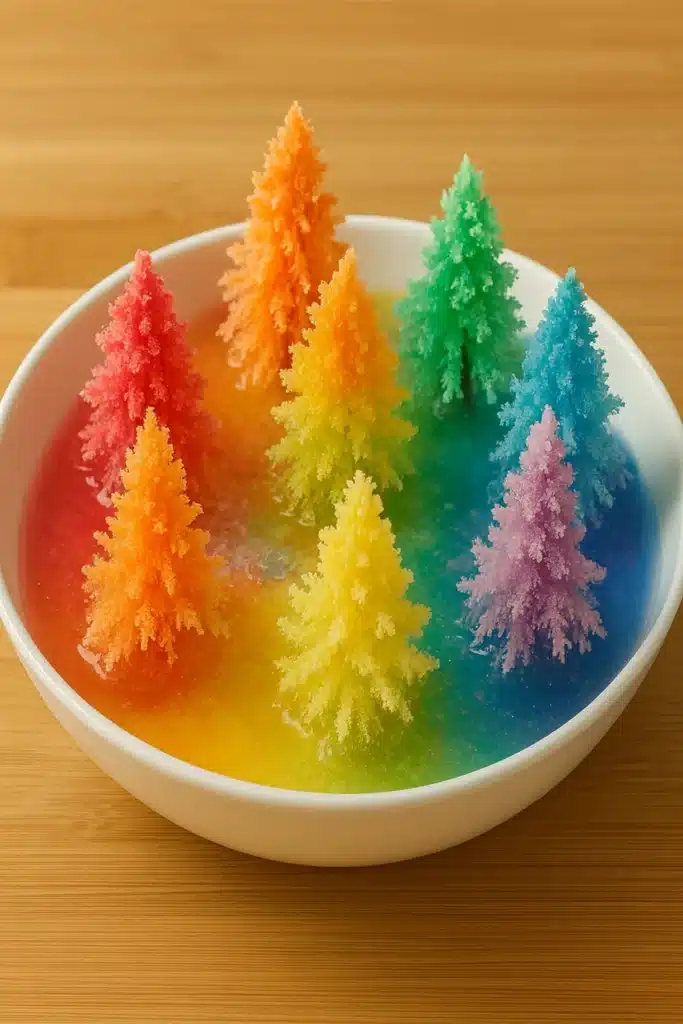
What Is a Baking Soda Growing Forest?
I still remember the first time I stumbled across this crystal growing experiment. I had no clue what to expect—just baking soda, some hot water, and a rainbow of food coloring. Didn’t seem like much. But then I left it overnight and bam!—by morning, we had this magical, snowy-looking forest creeping up the sides of our sponge trees. The kids? They lost their minds. It felt like Christmas in July.
Crystal Science Meets Playtime
This is more than just some cute DIY. It’s a kids science activity that secretly teaches how crystals grow from supersaturated solutions. Sounds like a mouthful, but it’s really just a fancy way of saying the baking soda piles up and forms crystals when the water cools and evaporates.
You pour this mix gently into a shallow dish lined with color, drop in a few sponge or pipe-cleaner trees, and wait. It’s like watching time-lapse magic in real life. The colors swirl, the soda climbs, and slowly a white crust forms like morning frost. Honestly, it’s one of the easiest STEM at home projects I’ve ever pulled off that looked so cool without costing more than a few bucks.
Why It Works: The Simple Science
Let me try not to sound like a textbook here—when you make a saturated solution with baking soda and hot water, it’s packed tight with the stuff. As the water evaporates, those little particles stick together and start forming solid shapes—aka crystals. The sponges and pipe-cleaners help because they act like little ladders for the crystals to climb.
This makes it a great intro to kitchen chemistry for kids. You don’t need lab gear. Just some basic pantry stuff and a bit of patience. The reaction isn’t explosive or messy, which, let’s be real, is a plus when you’ve got a 5-year-old who thinks every experiment should involve slime or soda explosions.
The Best Part? It Looks Gorgeous
I’m all about experiments that double as decor. These forests end up looking like frosted fairyland displays. I’ve even seen folks use them as centerpieces for winter-themed parties or to decorate around Christmas. Add a little glitter and you’ve got an art project disguised as science.
So yeah, a baking soda growing forest isn’t just a fun way to keep kids busy. It’s a legit STEM activity that introduces science basics in a super visual, hands-on way. Bonus points for making your kitchen look like something out of a snow globe.
Supplies You’ll Need to Start Your Forest
Okay, let’s talk gear. You won’t need anything fancy, I promise. This isn’t one of those DIY science kits that cost $50 and arrive in a giant box. Most of these items are already hanging out in your kitchen or craft drawer. But just to keep you from forgetting anything (been there), here’s a full checklist to make sure your crystal growing experiment kicks off without a hitch.
Basic Supplies for the Project
- Shallow white plate or dish – I use a flat pasta plate from the thrift store. The white really makes the colors pop.
- Baking soda (sodium bicarbonate) – Don’t skimp on this one. You’ll need a good amount to make a fully saturated solution. Buy the cheap bulk box!
- Hot water – Not boiling, but hot enough to help the baking soda dissolve.
- Food coloring (rainbow colors) – Red, orange, yellow, green, blue, purple. Liquid or gel both work.
- Sponge or pipe-cleaner trees – I’ve made these with dollar store sponges, cut into cone shapes, and twisted some green pipe-cleaners into mini evergreens.
- Small bowls or cups for mixing colors – Little prep bowls work perfectly.
- Spoon or stick for stirring – You’ll want something disposable or washable—it gets crusty.
- Optional: Glitter – For that snowy sparkle, especially if you’re doing a winter or fairy garden theme.
Pro Tip: Use What You’ve Got
One time I didn’t have enough sponges, so I cut up an old dish scrubber. Another time, I used bendy straws stuck in modeling clay as tree trunks. The best part of home science is hacking it with household stuff—don’t stress about perfection.
If you’re into STEM supplies for kids, you can get pre-made trees or mini science trays online, but honestly, half the fun is in the making. This project’s cheap, cheerful, and still looks straight-up magical.
Where to Find the Best Materials
- Grocery stores usually have baking soda and food coloring.
- Craft stores = glitter, pipe-cleaners, and sponges.
- Big box stores or Amazon if you’re building a DIY science kit for homeschoolers.
Keep it simple. If you’re working with a classroom or a group, just scale up and prep the baking soda solution in a pitcher ahead of time.
Trust me—once you’ve got your crystal growing materials ready, the hardest part is stopping your kids from poking the trees before the crystals finish growing. 😅
Step-by-Step Instructions to Grow Your Baking Soda Forest
Alright, so you’ve got your supplies laid out and your kids are already asking, “Is it growing yet?” I’ve been there. This part’s where the hands-on science magic happens—and it’s honestly kind of addictive. Whether you’re doing this as part of a STEM experiment for homeschool or just a rainy afternoon fun fest, here’s exactly how I pull it off.
Step 1: Make a Rainbow Base
Pour a shallow layer of hot water into your dish—just enough to cover the bottom.
Then, using a spoon, carefully drip food coloring around the edges in rainbow order. Don’t mix it! Let the colors sit in little puddles; they’ll blend beautifully once the crystals start forming.
This rainbow layer is the real eye-catcher in this how to grow crystals at home activity.
Step 2: Place Your Trees
Stand your sponge trees or pipe-cleaner creations upright in the dish. If they’re floppy, use a dab of clay or playdough at the base to keep them steady.
Make sure each tree touches the water—this is how the baking soda solution will travel up and “grow” on them.
Step 3: Mix a Saturated Baking Soda Solution
Now comes the chemistry. Heat up a mug of water until it’s hot (not boiling). Then start adding baking soda a spoonful at a time, stirring until no more will dissolve. You’ll know it’s fully saturated when some powder just sits at the bottom no matter how much you stir.
This is key to getting big, dramatic crystals in your STEM crystal growing experiment.
Step 4: Pour Slowly and Gently
This part’s like threading a needle. Very gently, pour the baking soda solution over the dish. Aim for the center and let it flow out toward the trees. Try not to disturb the food coloring too much—it’s what makes the rainbow effect.
Tip: If you pour too fast, the colors will blend into brown sludge. Been there, cried a little.
Step 5: Let It Sit and Work Its Magic
Now… wait. This is the hardest step for little ones, no joke.
Leave the dish untouched for a few hours (or overnight). As the water evaporates, you’ll see tiny white crystals start to form. Then—bam!—they climb the trees, spread across the plate, and fluff up like fake snow.
It’s honestly mesmerizing. I once checked every hour like it was baking cookies.
Step 6: Optional Swirl for a Snowstorm Look
For bonus cool points, pour a few drops of plain hot water into the center once crystals start forming. It softens the middle and makes a gorgeous snowy swirl. I do this when I want that “winter forest” vibe.
This whole project takes maybe 20 minutes of setup and gives you a full day of awe and “whoa, look at that!” reactions. It’s one of my all-time favorite STEM science activities—not just because it’s pretty, but because it shows kids how chemistry works in real time, without a single worksheet.
Tips for Best Results and Troubleshooting
Let me be real for a second—my first baking soda forest was a flop. No crystals. Just a swamp of purple goop and two sad-looking sponge trees. 😅 But after some trial, error, and late-night Googling, I figured out what went wrong. If you want your forest to actually grow and look awesome, keep these crystal science experiment tips in your back pocket.
Tip 1: Use HOT Water (Not Warm)
This one’s huge. If your water’s not hot enough, the baking soda won’t fully dissolve, and you’ll miss that supersaturation sweet spot.
Microwave your water for about 45 seconds to 1 minute. It doesn’t have to boil—just steaming. This helps max out the amount of baking soda it can hold.
Tip 2: Make Sure the Solution Is Saturated
You’ve gotta stir in baking soda until no more dissolves. Like, really go for it. I usually keep adding spoonfuls until there’s a little pile at the bottom that just sits there no matter what.
This is how you avoid one of the most common baking soda science problems: weak, patchy crystals that barely grow.
Tip 3: Don’t Disturb the Dish After Pouring
I made the mistake of poking the trees “just to check” and it ruined everything. The colors mixed into a brown mess and the crystals stopped forming.
Set it somewhere quiet—away from curious hands and window breezes. Crystal growth is a slow game, but worth the wait.
Tip 4: Keep It in a Dry Room
Humidity kills the magic. If your kitchen is steamy (like after making soup or running the dishwasher), move the forest somewhere else.
Dry air = faster evaporation = bigger crystals.
Tip 5: Use White Dishes for Maximum Contrast
This isn’t required, but I swear by white plates or bowls. The rainbow food coloring and bright white crystals show up way better. Makes your Instagram shots look amazing too (just sayin’).
If It’s Not Working… Here’s What to Try:
- Crystals not forming? Your solution may not be saturated enough. Try again with hotter water and more baking soda.
- Colors mixed into brown mush? You probably poured too fast or stirred the water. Next time, go slow and avoid touching anything once it’s set up.
- Crystals too thin or flaky? That’s usually due to too much water. Use less next time, just enough to wet the bottom of the dish.
This part of the project can feel like baking without a recipe—but once you get the rhythm, it’s easy. Seriously, I’ve had 5-year-olds get better results than me because they just left it alone.
And remember, even if it doesn’t work the first time, it’s still a cool way to teach how crystals grow and what affects their formation. Science is about messing up and trying again. The magic’s in the learning.
Creative Variations and Themed Forest Ideas
Once you’ve nailed the basic baking soda forest, the real fun starts—customizing it! I swear, I’ve gone down the rabbit hole with this part. What began as a simple crystal science project turned into a full-blown hobby at our house. We’ve done holiday-themed science activities, galaxy forests, and even a Minecraft crystal cave. (Yes, it got a little out of hand.)
So if you want to turn this into a full-on DIY art-meets-science experience, try these wild and wonderful variations.
Winter Wonderland Forest ❄️
- Use only cool-toned food coloring: blues, purples, silver.
- Add white glitter for that fresh snow sparkle.
- Cut your sponge trees into snowy pine shapes.
- Set it on a mirror base for a frozen lake look.
This makes an amazing Christmas science craft and doubles as a decor piece!
Autumn Forest 🍂
- Stick with red, orange, and yellow food coloring.
- Use brown or tan pipe-cleaners for a “bare tree” look.
- Add cinnamon or clove essential oil for fall vibes.
Perfect for cozy seasonal STEM activities when leaves are falling outside and hot cocoa is on repeat.
Galaxy Crystal Forest 🌌
- Go bold: use black or navy food coloring in the center with hints of neon green, hot pink, and deep purple.
- Add silver or holographic glitter.
- Swap sponges for star-shaped foam pieces or black pipe-cleaners.
This version looks like something straight out of a sci-fi movie and is a favorite among older kids and tweens. It’s also a showstopper for science fairs.
Fairy Garden Theme 🧚♀️
- Soft pastel colors, biodegradable glitter, and butterfly stickers.
- Add mini fairy figurines or mushroom cutouts.
- Use floral-shaped sponge cutouts instead of trees.
Honestly, this one’s a hit with kids who are more into the artistic side of DIY science crafts for kids.
Glow-in-the-Dark Forest 🌟
- Use glow food coloring or tonic water under a blacklight.
- Keep your sponge trees simple to let the light do the talking.
- Optional: Add a tiny LED or tea light underneath the dish for a glowing effect.
It’s perfect for parties, night-time experiments, or just blowing your kids’ minds after dinner.
You can theme these around holidays, birthdays, classroom units—whatever! And the best part? They still teach the same crystal science concepts. It’s just layered with imagination and creativity. I always say, the more fun they’re having, the more they’re learning without even realizing it.
So go ahead. Let your inner mad scientist meet your inner craft nerd. Because in the end, these creative crystal projects are more than pretty—they’re unforgettable experiences that get kids excited about science.
If you’ve made it this far—high five! 🙌 You’re officially ready to create your own snowy, sparkling, baking soda forest that’s part magic, part science, and 100% fun. Whether it’s your first experiment or your fifth themed version, this activity has a way of surprising you every time. The moment those crystals start creeping up the trees? It never gets old.
You don’t need fancy gear, a science degree, or a big budget. Just some basic crystal growth experiment supplies, a little hot water, and a dash of creativity. It’s that perfect combo of educational science activity and artsy playtime that keeps kids curious and engaged—and let’s be honest, we adults kind of love it too.
If this became your new favorite fun science for kids project, don’t keep it to yourself—share your results on Pinterest! Snap a few pics of your forest and pin this guide so other families, teachers, or curious minds can join the fun. Science is better when it spreads.
So, go ahead—grab those sponges, stir up your solution, and let your forest grow! 🌲✨

I want to make later
how do actually make the trees
Can you share how you did the Minecraft cave?