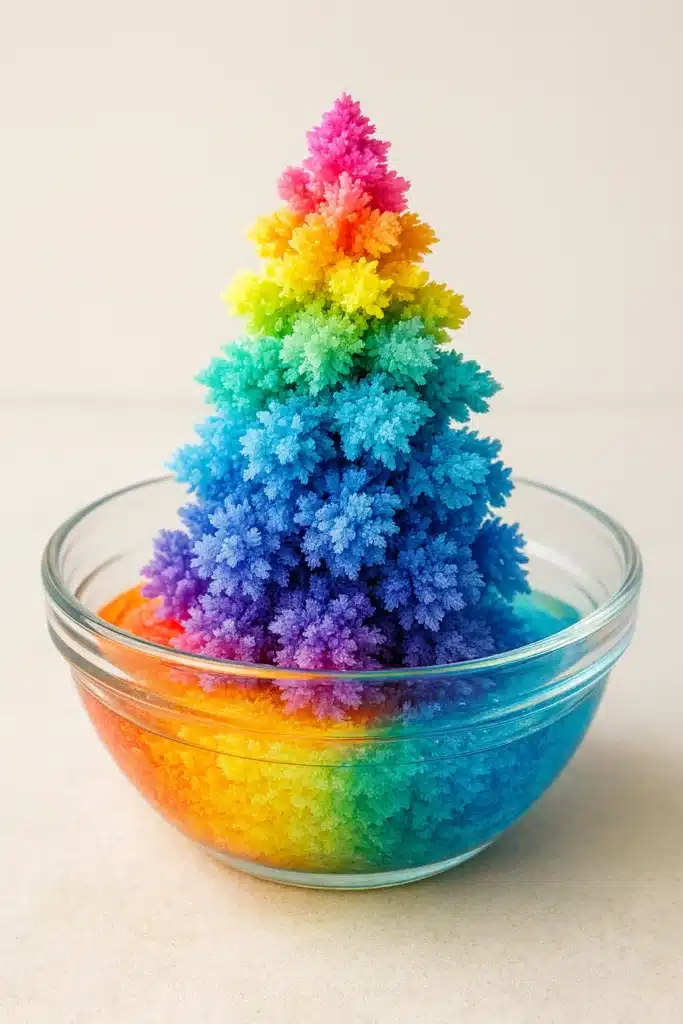
Ever thought a science experiment could double as your Christmas centerpiece? That’s exactly what happened the first time I made Rainbow Crystal Christmas Trees. I was just looking for a fun craft—and boom!—my kitchen turned into a glittering winter wonderland. Using Epsom salt, a few household items, and a splash of color, this DIY blends chemistry with creativity in a way that makes both kids and adults go “WOW!”
Not only is it a fantastic hands-on project, but it also teaches crystal formation in real time. Whether you’re decorating your classroom, entertaining the kiddos, or just adding Pinterest-worthy flair to your home, these trees are the ultimate win.
Let’s dive into the rainbow!
How to Make the Paper Christmas Tree Cutouts
Crafting the Perfect Base for Crystal Magic
Alright, full confession—my first attempt at this DIY Christmas craft looked more like a wilted cactus than a festive tree. I used flimsy printer paper, and it just collapsed under the crystal solution. Rookie mistake. If you want your crystal-covered tree to stand proud and tall (and not melt into a soggy mess), cardstock or thick cardboard is your best friend.
🎨 Choosing the Right Materials
So here’s the deal: don’t skimp on the paper. Go for heavy-duty paper, ideally around 200gsm. You can even reuse old cereal boxes—eco-friendly and sturdy. I traced out two identical tree shapes using a basic Christmas tree template I found online (seriously, just search “Christmas tree template printable”—there are tons). You could freehand it, but I like symmetry. And I don’t trust my drawing skills when I’ve had three cups of peppermint mocha.
✂️ Cutting and Slotting: The Secret Sauce
Once you’ve got your trees traced and cut, here’s the part that matters most for the stand-up factor. Take one tree and cut a slit from the bottom halfway up. Take the second tree and slice it from the top halfway down. When you slide them together, they should form a standing 3D tree—like a little paper miracle. If they lean or wobble, don’t panic. A dab of hot glue at the base can stabilize it.
Oh, and a tip from the trenches? Cut the slits just a tiny bit wider than the paper thickness. If it’s too tight, they’ll rip. If it’s too loose, your tree will flop like a sad noodle.
🖍️ Decorating Before the Crystals
Before I even touch the crystal solution, I get wild with the markers, stickers, and a bit of holiday glitter. The crystals will grow over everything, but those little accents still shine through and make each tree feel personal. I once let my niece draw tiny ornaments and candy canes—it looked like something out of a Hallmark card after the crystals formed.
🧠 Pro Tips for Tree-Making Success
- Use holiday cookie cutters as shape guides for cleaner lines.
- Pre-fold a crease down the middle of both trees so they align better when slotted.
- Test the base balance before adding solution—you don’t want it tipping mid-crystallization.
- Add a small dot of clear tape at the top or bottom if it feels too loose.
Honestly, this part is my favorite because it’s all about creativity and zero pressure. Even if the cutout is a little off, once the crystals start growing, it all looks magical. Plus, it’s a great way to get kids involved in a hands-on Christmas decoration project that actually teaches them something. I mean, who says you can’t mix holiday fun with STEM learning?
So take your time, crank up the carols, and get snipping. Your crystal tree journey starts here!
Mix Your Magical Crystal Solution
The Secret Sauce Behind the Sparkle
Okay, this part? This is where the science gets fun. I used to think growing crystals was some complicated lab experiment you needed a microscope for. Nope. All it takes is Epsom salt, warm water, and about five minutes of stirring—seriously.
🧂 Epsom Salt vs. Regular Salt
I’ve tested both. Regular table salt works, but it grows slower and forms these small, frost-like crystals. Pretty, sure, but not what you want for that dramatic “Pinterest-worthy” look. Epsom salt is the MVP here. The crystals shoot up like frosty towers—sharp, glittery, and tall. Perfect for Christmas vibes.
I always grab a big bag from the pharmacy or online—look for USP grade Epsom salt, the same kind folks use for bath soaks. It’s cheap and lasts forever. And no, scented versions won’t work. Trust me, peppermint-scented snow sludge is not festive.
🔥 Get the Temperature Right
Here’s where I used to mess up: water that’s too cold. You need hot-but-not-boiling water to dissolve the salt properly. I heat about ½ cup in the microwave for 30–45 seconds—warm enough to touch but not steaming.
Then I stir in the salt slowly, bit by bit. Keep adding and stirring until it just stops dissolving. That’s how you know it’s fully saturated. Usually, it takes around ¾ to 1 cup of Epsom salt. Once a little starts settling at the bottom, you’re golden.
Let it sit and cool down for a couple of minutes. That brief cooling helps start the crystal seed process, which makes everything form faster. (Yes, I geeked out reading about this.)
🧪 Why Saturation Matters
This is the part no one talks about in those quick TikToks: if the solution isn’t saturated, no crystals will grow. You’ll just end up with soggy paper and disappointment. When it’s properly saturated, the crystals start climbing up the tree within 30 minutes. Instant holiday magic.
🧠 Quick Tips for Foolproof Crystals
- Use a clear glass or bowl so you can see if salt is settling.
- Stir with a metal spoon—it conducts heat better and speeds up dissolving.
- Label your measuring cups if you’re doing this with kids; things can get messy fast.
- Double the batch if you’re making more than one tree (or just addicted to crystal growth like me).
Honestly, once I figured this part out, it unlocked the entire project. It feels like mixing a crystal growing kit in your own kitchen—and the fact that it doubles as a Christmas science experiment? Total bonus. It’s one of those rare crafts where kids and adults both stare at it like, “Whoa, how is this even real?”
Next step? Time to add some color and turn that solution into a rainbow. Ready? Let’s go!
Color It Like a Rainbow – Add Food Coloring
From Clear Solution to Vibrant Holiday Magic
I’ll admit—this is the part where I turn into a total kid again. There’s just something ridiculously satisfying about watching color wick up a paper tree like it’s sipping a rainbow smoothie. If you’ve ever done a tie-dye shirt, this hits the same dopamine button but with a holiday twist.
🟢🟡🔴 Setting Up Your Color Cups
You’ll want about 4–6 small cups or bowls—think Dixie cups or little plastic containers. Into each one, I pour 2 tablespoons of the crystal solution we just made. Then comes the fun part: food coloring.
I go classic ROYGBIV. That’s red, orange, yellow, green, blue, and sometimes pink or purple for the top. Just 1–3 drops of food coloring per cup is enough. More than that and you risk making your tree look like it took a dive into a Slurpee machine. Ask me how I know.
🖌️ Tools That Make It Cleaner (and More Fun)
You can absolutely just pour the colors onto the tree with a spoon. But for more control—and less mess—I use a small paintbrush or pipette. That way I can dab specific sections of the paper tree and control the gradient better.
Start with blue at the base, then green, yellow, and so on until you hit pink or red at the top. I try not to overthink it. The paper does the work for you—as the liquid gets absorbed upward, the colors naturally blend like a watercolor painting.
🎨 Creating a Smooth Rainbow Gradient
At first, I got super picky about color placement. But then I realized the wicking action of the paper actually blends everything better than I ever could. Like, it turns your precise dabs into this dreamy, soft ombré that looks like it belongs in a boutique shop window.
Plus, the color doesn’t stay just in one spot. As the crystals grow, the hues spread and swirl up the branches. It’s like watching a rainbow science experiment in slow motion.
🧠 Smart Color Tips I Learned the Hard Way
- Avoid mixing colors in the same cup—it turns into brown sludge real quick.
- Start light (yellow, green) and go darker—darker colors tend to overpower.
- If you want pastel crystals, use gel food coloring and dilute more.
- Want bolder color? Add a second drop of coloring once crystals start forming—it intensifies the look.
I’ve even tried metallic food coloring once—gave the tree this icy, glimmering sheen that made it look half-frozen, half-magical. Kind of like Elsa touched it.
Adding color isn’t just about pretty pictures—it’s where your tree gets personality. Whether you go full rainbow unicorn vibes or stick to classy reds and golds, it’s the part where your creativity shines.
Up next? Time to put it all together and let the magic begin ✨
Add Solution to the Tree & Watch the Magic Start
When the Real Magic Kicks In…
Okay, this is the moment that makes everyone stop mid-sentence. The first time I poured the clear solution into the tray, I had zero expectations. I figured it’d take all night to see anything. Nope. Within 30 minutes, I started seeing tiny spikes forming along the paper edge. It was like Mother Nature pulled a holiday prank—surprising and gorgeous.
🥄 Pouring the Base Solution
First up, I always start with 2–3 tablespoons of the plain, clear crystal solution right at the base of the paper tree. This helps the whole structure start wicking moisture from the bottom up. Make sure your tree is standing straight in a shallow dish—a rimmed plate or baking tray works best.
If the tree flops over now, it’s game over. Learned that the hard way. I once had a lopsided tree that absorbed all the solution on just one side. Looked like a frosted bush. Still cute, but not the Pinterest moment I was going for.
🎨 Dabbing the Rainbow On
Now the fun part: using a paintbrush, pipette, or even a spoon, I dab the different colored solutions onto different sections of the tree. You don’t need a ton—just a little at a time.
I usually go in this order (from bottom to top):
- Blue at the bottom branches
- Green above that
- Then yellow
- Orange or red closer to the top
- And sometimes pink or purple right at the tip
It looks a little funky at first, like a preschool art project. But as the paper wicks the liquid upward, the colors blend and crystalize in real time. It turns into this insanely cool, rainbow crystal growing experiment.
🌬️ Set It and Forget It (Seriously)
Once everything’s on the tree, I walk away. No touching. No poking. No moving. This was tough for me at first. I’m a chronic “check on it” person. But trust me—just leave it in a warm, dry area and go binge a Christmas movie.
Within 15–30 minutes, you’ll start seeing tiny glittery specks. After about four hours, it looks like someone dipped your tree in rainbow snow. Epsom salt crystals form these long, fluffy towers that climb every branch. And the colors? They somehow get even more vibrant.
🧠 My Real-Life Tips for Success
- Put your dish on a flat surface near a sunny window or heater vent—dry warmth speeds up crystal formation.
- If it’s humid in your house, run a dehumidifier or place it in a small closed room with a space heater.
- Add a few grains of salt to the base of the paper before pouring solution—this seeds the growth and speeds it up.
- Don’t go overboard with liquid! Too much = soggy tree. You want it just damp enough to wick, not soaked.
It’s wild how simple ingredients—water, salt, food coloring, and paper—can turn into something this magical. I’ve had guests walk in and think I bought them from some fancy holiday shop. Nope, just good old-fashioned DIY chemistry.
Coming up next? Let’s talk about what happens once the crystals start growing… and how to make them even fluffier.
Let It Grow – Crystal Formation Timeline
From Wet Paper to Frosty Wonder in Hours
Alright, here’s the part where you need just a tiny bit of patience. Not a ton—this isn’t sourdough starter or anything. The cool thing about this fast-growing crystal project is that you’ll see results pretty quick. Like, grab-a-snack-and-watch-it-happen quick.
🕒 The 30-Minute Sparkle Check
I always set a timer for about 20–30 minutes after I finish applying the solution. That’s when I start checking for those first little sparkles—tiny, spiky crystals poking out along the paper edges. The first time I saw them, I actually yelled, “It’s working!” like some giddy holiday scientist.
If nothing happens in 30 minutes, don’t panic. It could just be a little too cool or damp in the room. This stuff is super sensitive to air conditions. But when it’s dry and warm? You’ll see magic almost instantly.
🕓 The 4-Hour Crystal Bloom
Here’s the real transformation. At about 4 hours in, the crystals go from dust-sized flakes to full-on fluffy crystal clusters. The color starts climbing the paper tree in layers, mixing and twisting into that signature rainbow effect.
I once left mine overnight by accident and came back to what looked like a tiny frozen coral reef. The colors had fully bloomed, the crystals had hardened, and the whole thing shimmered like a snow globe.
🧂 What Makes Crystals Grow Faster (or Slower)
The #1 thing I’ve learned: environment matters.
- Warm and dry = FAST crystal growth
- Cold or humid = SLOW or no growth at all
If your kitchen or craft area tends to be chilly, pop the tree into a sunlit room, or near a heating vent. I’ve even used a closet with a small heater and it worked like a charm.
And hey—don’t be afraid to sprinkle a little extra Epsom salt “dust” on the paper before the solution dries. It acts like seed crystal, and gives your tree a head start.
🧠 Quick Crystal Timeline Cheat Sheet
- 0–30 mins: First specks of growth appear
- 1–2 hours: Color begins spreading and climbing
- 4+ hours: Full “fluffy tree” transformation
- Overnight: Maximum growth and sparkle
Watching this happen still gets me every time. It’s part science, part art, and 100% satisfying. Like watching a holiday-themed science experiment unfold in real-time.
Next up? Let’s talk tips, tricks, and some fun creative variations you have to try.
Tips, Tricks & Creative Variations
Go Beyond the Basics – Customize Your Crystal Tree!
Once you’ve made one of these crystal trees, you will want to make more. Trust me. I started with one rainbow tree… and next thing I knew, my whole windowsill looked like a North Pole lab experiment. The best part? You can customize everything.
🌟 Salt Swaps: What Changes?
So, we’ve talked about Epsom salt being the go-to. But what happens when you swap it out?
- Table salt: slower growth, smaller “frost” crystals. Looks like snow dust—super cute for a “white Christmas” theme.
- Baking soda: grows even slower, but the results are soft and snowy. Think: “Marshmallow Christmas vibes.”
- Borax: Not ideal here—it forms harder crystals that don’t wick as well on paper.
If you’re doing this as a Christmas STEM activity with kids, test two trees side by side using different salts. They’ll geek out seeing the difference.
✨ Add Glitter for Extra Holiday Glam
Sprinkle fine glitter on the damp tree right before crystal formation. It bonds into the salt and adds this magical shimmer that sparkles under lights.
Bonus tip: use iridescent glitter. It picks up all the rainbow tones in the crystals without overpowering the color.
🖍️ Creative Shapes & Styles
Why stop at Christmas trees? Here’s what I’ve tried:
- Snowflakes: Use paper snowflake cutouts. Super delicate and pretty.
- Stars: Great for tree toppers or window displays.
- Mini trees on popsicle sticks: These make adorable handmade gifts or classroom crafts.
Trace simple shapes onto thick cardstock and follow the same crystal process. Just be sure they’re sturdy enough to stand or lay flat.
🧠 My Personal Crystal Growth Hacks
- Seed with salt: Rub a tiny bit of Epsom salt into the tree before adding solution.
- Use filtered water: Minerals in tap water can mess with the crystal clarity.
- Elevate your dish: Place your tray on an old baking rack—this helps airflow and speeds drying.
Also… don’t forget to take photos! Crystals can be fragile once dried, and trust me, you’ll want to show these off. They’re seriously Pinterest holiday DIY gold.
Whether you’re decorating the house, running a winter science lab, or just need a cozy craft night, these trees bring out the perfect mix of festive and nerdy fun. And hey, who doesn’t want a little chemistry with their cocoa?
Creating Rainbow Crystal Christmas Trees isn’t just a craft—it’s an experience. It blends science, color, patience, and creativity all in one project. Whether you’re crafting solo, with a classroom, or just for fun, this DIY leaves you with sparkling joy and a cool science lesson.
Try it out and don’t forget to pin your results to Pinterest! Let’s spread the sparkle 🎄✨

This is amazing. I do so wish google wouldnt cover half the page with ads for the entire duration though. It exhausting getting the instructions secured. Now all that complaining aside, you are amazing!